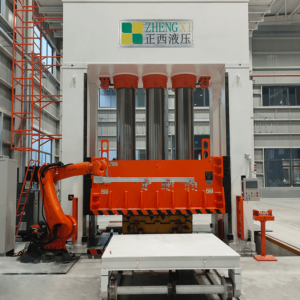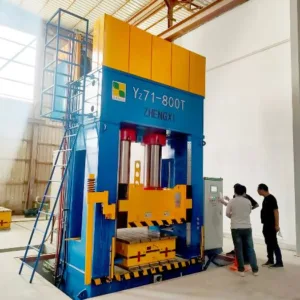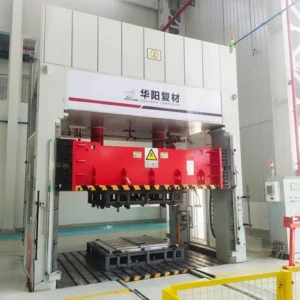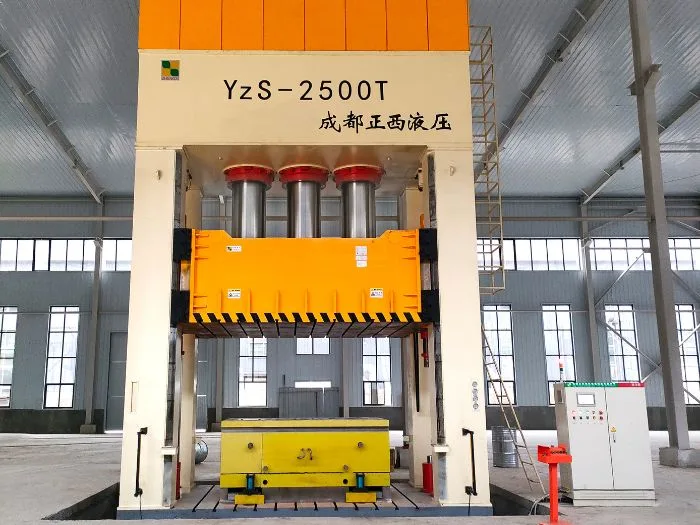

Molding process of Carbon fiber hydraulic press:
Lay the carbon fiber prepreg flat between the upper and lower molds. After the mold is sealed, place the mold on the hydraulic molding table. The resin and prepreg are solidified by high temperature and high pressure over time on a special carbon fiber molding hydraulic press, and the carbon fiber product is removed from the hot press. This molding process has the advantages of high strength, high precision, lightweight, little environmental impact, and is conducive to mass production. It is suitable for mass and standardized parts production.
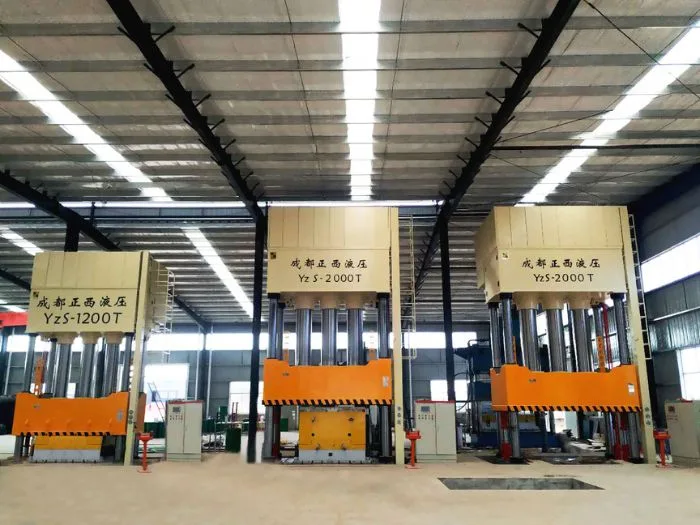
Features of Carbon fiber hydraulic press
● PLC + touch screen integrated control, pressure, temperature, and segmented inflation are adjustable.
● Heating methods such as electric heating pipe, steam heating, or thermal oil heating can be freely chosen.
● The “X” shaped plane guide structure has high guiding accuracy, long guide plate life, and a small degree of heat radiation influence.
● The prestressed combined frame improves the fatigue resistance and equipment rigidity of the frame, which is conducive to ensuring product quality.
● The dimensional accuracy of the stamping parts is controlled, and the equipment accuracy level reaches the precision level, which can meet the higher accuracy requirements of the stamping parts.
Advantages of Carbon fiber hydraulic press:
1. Accurately control the pressure value.
2. Accurately control the speed and position.
3. Edit and save the corresponding product number of the program at will.
4. Accurately control the temperature of the hot plate.
5. High-pressure resistant and high-efficiency insulation board insulates 80% of the heat energy.
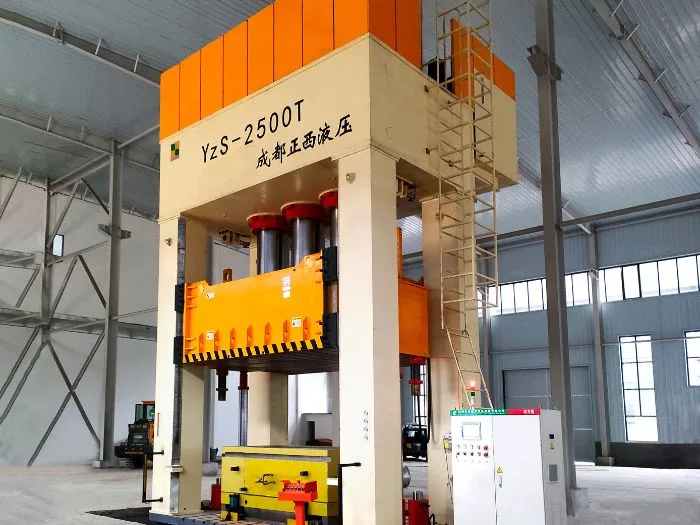
Application of Carbon fiber hydraulic press
Carbon fiber hydraulic press suits the military industry, aviation, high-speed rail, electric vehicles, drones, automobiles, motorcycles, and insoles.
| Description | Unit | 100T | 200T | 315T | 500T | 630T | 1000T | 1500T | 2000T | |
| Nominal Force | KN | 1000 | 2000 | 3150 | 5000 | 6300 | 10000 | 15000 | 20000 | |
| Pressure of fluid | Mpa | 25 | 25 | 25 | 25 | 25 | 25 | 25 | 25 | |
| Slider stroke | mm | 600 | 800 | 800 | 1200 | 1200 | 1600 | 1600 | 2000 | |
| Opening height | mm | 900 | 1200 | 1200 | 1600 | 1600 | 2000 | 2000 | 2000 | |
| Ejecting stroke | mm | 150 | 170 | 180 | 180 | 180 | 200 | 220 | 250 | |
| Preload pressure | KN | 315 | 630 | 1000 | 1500 | 2000 | 3150 | 5000 | 6300 | |
| Opening Mould Force | mm/s | 200 | 400 | 630 | 1000 | 1250 | 2000 | 3150 | 4000 | |
| Demould Force | mm/s | 100 | 200 | 500 | 500 | 500 | 500 | 500 | 500 | |
| Down Speed | mm/s | 200 | 200 | 200 | 200 | 200 | 300 | 300 | 300 | |
| Working speed | mm/s | 1—6 | 1—6 | 1—6 | 1—6 | 1—6 | 0.5—5 | 0.5—5 | 0.5—5 | |
| Return Speed | mm/s | 100 | 100 | 100 | 150 | 150 | 200 | 200 | 200 | |
| Preload Speed | mm/s | 6—25 | 6—25 | 6—25 | 6—25 | 6—25 | 5—30 | 5—30 | 5—30 | |
| Demould Speed | mm/s | 5—30 | 5—30 | 5—30 | 5—30 | 5—30 | 5—30 | 5—30 | 5—30 | |
| Table Size | L.R. | mm | 630 | 900 | 1200 | 1400 | 1600 | 3200 | 3200 | 3200 |
| F.B. | mm | 630 | 900 | 1200 | 1400 | 1600 | 2200 | 2200 | 2500 | |
| Master Pump Power | KW | 11 | 18.5 | 30 | 45 | 75 | 110 | 180 | 230 | |
| Weight | T | 4.2 | 12 | 22.5 | 43.5 | 56 | 112 | 162 | 222 | |